

Introduction to the Witch of Villejuif Killings: France’s Dark Chapter of Occult Crimes
France, long celebrated for its Enlightenment ideals and rationalist heritage, was shaken in the late 20th century by the chilling “Witch of Villejuif” killings. These infamous crimes from the 1980s–1990s revealed that fears of witchcraft and occult practices were far from extinct, resurfacing in a modern European society that believed itself immune to such superstitions. The case exposed how folklore, dark rituals, and superstition could still influence lives—and deaths—in contemporary France. In this blog, we uncover the haunting story behind the Witch of Villejuif murders, their impact on French society, and their place within the wider history of witchcraft-related violence in Europe.
The Setting: Villejuif and the Shadow of the Occult
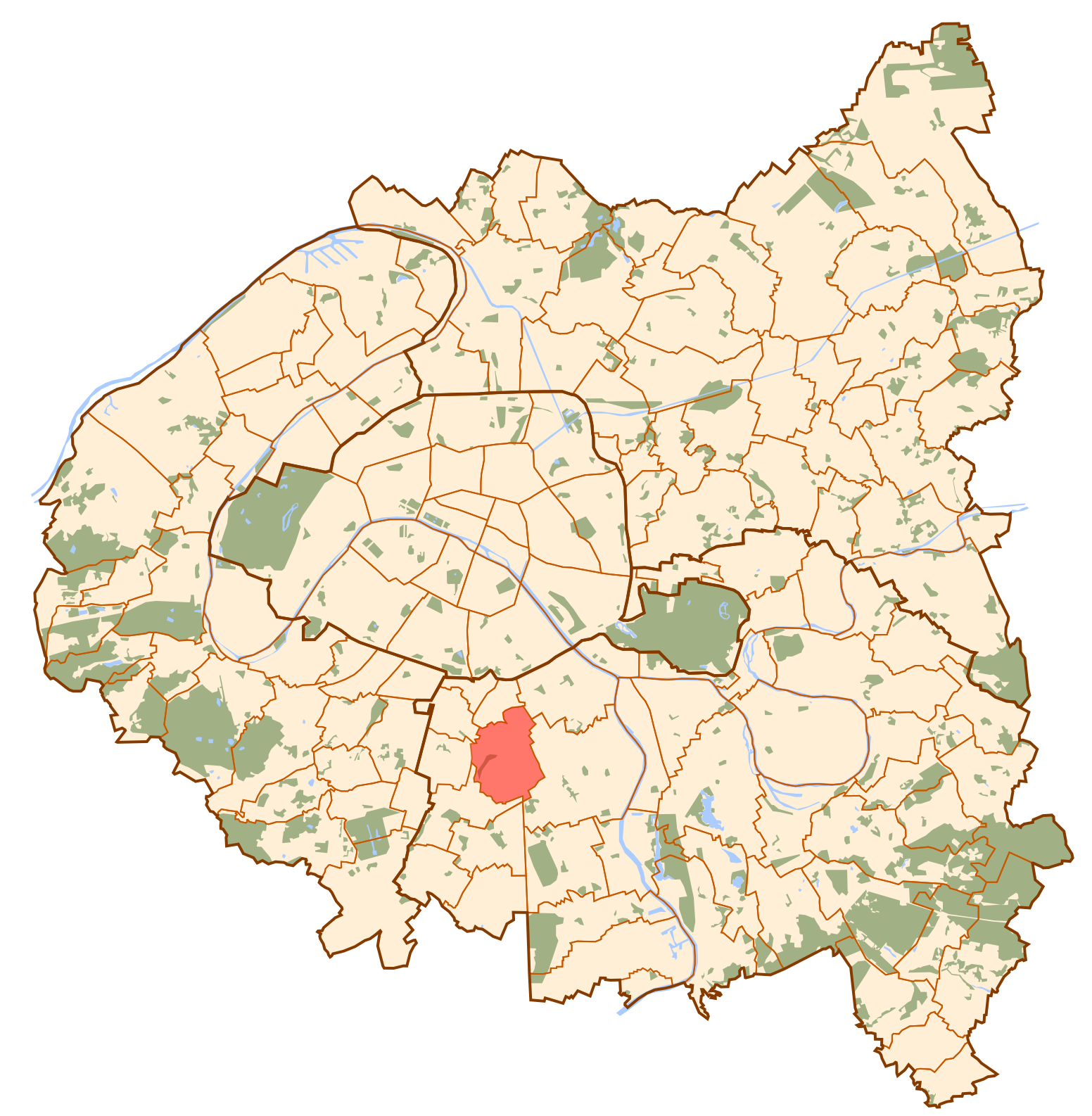
Villejuif, a quiet commune in the southern suburbs of Paris, might seem an unlikely backdrop for a story of ritualistic violence. By the 1980s and 1990s, France had become a modern, urbanized, and largely secular nation. Yet beneath this progressive surface, lingering folk beliefs in witchcraft, curses, and magical harm still held power—especially in rural regions and even within suburban communities like Villejuif. These undercurrents of superstition created fertile ground for fear, fascination, and, ultimately, the tragic events tied to the infamous “Witch of Villejuif” killings.
Witchcraft in Modern France

Although the infamous witch trials had largely disappeared by the 18th century, the fear of witchcraft never fully vanished from French society. Historians note that beneath the surface of modernity, accusations of sorcery and anxieties about curses persisted well into the 20th century. In some cases, these lingering superstitions erupted into violence—driven by desperation, scapegoating, and paranoia. The “Witch of Villejuif” killings of the 1980s–1990s serve as a stark reminder that witchcraft beliefs were not relics of the distant past, but dangerous forces that could still shape lives and tragedies in modern France.
The Killings: What Happened?
The disturbing events remembered as the “Witch of Villejuif” killings unfolded in the late 1980s, when two men—Richard Roman and Didier Gentil—committed a crime so shocking that it horrified France and reignited fears of ritual murder and occult activity.
The Murder of Céline Jourdan

In late July 1988, seven-year-old Céline Jourdan disappeared from the quiet village of Motte-du-Caire in southeastern France. The following morning, her lifeless body was discovered in a dry creek bed, sparking a nationwide investigation.
Authorities quickly arrested Richard Roman, an agronomist-turned-goatherder nicknamed “Indian,” and Didier Gentil, a drifter known as “Tattoo.” Social outcasts who had formed their own twisted pseudo-cult, the pair were obsessed with ritualistic violence and occult symbolism.

The crime bore all the hallmarks of a so-called “ritual murder.” Céline had been kidnapped, tortured, sexually assaulted, and ultimately killed in what police described as a “sacrificial rite.” Disturbingly, Roman and Gentil were the only members of their invented cult, fueled not by tradition but by a toxic mix of personal psychosis and distorted occult ideas.
Even hardened investigators admitted they were sickened by the details. The ritualistic overtones—though rooted in delusion—deeply unsettled both police and the public, cementing the case as one of France’s most haunting modern crimes.
Media Frenzy and National Shock
The horrific murder of Céline Jourdan—and the bizarre ritualistic elements surrounding it—sent shockwaves across France. A young, innocent victim, paired with the occult undertones and the eccentric backgrounds of the perpetrators, made the case irresistible to the press. Headlines warned of ritual murder, satanic panic, and the resurgence of witchcraft in a supposedly rational, modern nation.
During the height of Europe’s 1980s–1990s Satanic Panic, the French media amplified fears of cults and occult practices. Some outlets even dubbed the case the “Witch of Villejuif” killings, linking it—fairly or not—to a broader tradition of black magic and witchcraft. In reality, Roman and Gentil’s beliefs were not part of an organized cult but rather a twisted, delusional system of their own making.
Witchcraft Belief: Not an Anachronism

Historians emphasize that witchcraft beliefs, magical harm, and ritual healing did not vanish with the Enlightenment or the end of witch trials. Instead, these ideas persisted beneath the surface of modern life in France, shaping fears and even fueling crime well into the 20th century.
Far from being a mere relic of the past, the Villejuif case revealed how occult anxieties could manifest in modern forms. While most accused “witches” were historically folk healers or so-called “unwitchers,” in rare and chilling cases, witchcraft was invoked as justification for violence. The Witch of Villejuif killings became a stark reminder that superstition still carried deadly consequences.
The Investigation and Aftermath

After their arrest, both Richard Roman and Didier Gentil were placed under psychiatric evaluation. Authorities feared for their mental stability—and for their safety—since news of their crime sparked outrage among both inmates and the wider public.
The investigation uncovered a disturbing portrait of alienation and fantasy. Roman, once an educated agronomist who abandoned his career for rural isolation, and Gentil, a transient drifter, fed off each other’s delusions. Their so-called “rituals,” while borrowing language and imagery from occult traditions, were unique to them—an unsettling mix of psychosis, obsession, and violence that culminated in tragedy.
Motives: Occult Delusion and Ritual Violence
Why did Richard Roman and Didier Gentil commit such a horrific crime? Was the murder of Céline Jourdan truly an act of witchcraft, or was the occult merely a narrative overlay on a deeper psychological disorder?
Delusional Belief Systems
Roman and Gentil created a private mythology of sacrifice and ritual, borrowing fragments from occult folklore to justify their violence. Their cult was not rooted in authentic witchcraft traditions but in a self-made belief system shaped by obsession and paranoia.
Social Isolation and Alienation
Both men lived on the margins of society. As outcasts, magical thinking may have offered them a distorted sense of meaning, power, or control. Their isolation amplified their descent into fantasy and delusion.
Cultural Anxieties of the Era
The crime unfolded during the height of the 1980s–1990s Satanic Panic, when Europe and the United States were consumed by fears of ritual abuse and secret cults. The narrative of witchcraft and ritual sacrifice tapped into—and may even have been influenced by—these broader moral panics circulating in the media and society.
Importantly, historians stress that Roman and Gentil’s so-called “cult” was homegrown. Their practices were cobbled together from media tropes, fragments of folklore, and their own pathological imagination, rather than any established witchcraft or occult tradition.
The Legal and Psychiatric Response
The trial of Roman and Gentil blurred the boundaries between criminal justice and psychiatric evaluation. Prosecutors and medical experts agreed that the case was as much about mental illness as it was about ritual violence.
In the eyes of the court, the central question was not the content of their beliefs but their capacity to distinguish fantasy from reality—and whether they bore legal responsibility for their actions.
The proceedings reflected France’s broader struggle to interpret crimes that felt both modern, in their senseless brutality, and archaic, in their ritualistic disguise. The Witch of Villejuif killings thus became a case study in how societies grapple with violence cloaked in the language of the occult.
Witchcraft and Violence in Modern France

The Witch of Villejuif case was not an isolated tragedy. Well into the late 20th century, violence linked to witchcraft beliefs continued to surface across France. As historian Will Pooley has documented, attacks on suspected “witches”—often elderly or socially marginalized individuals—were occasionally reported. These outbreaks, though rare, typically erupted after long-simmering community tensions and revealed the enduring cultural power of superstition.
Such incidents remind us that witchcraft fears never vanished; instead, they evolved. The boundary between crime and folklore, between personal grievances and collective belief, often remained blurred.
Public Reaction: Shock and Denial
In the wake of the Villejuif killing, French commentators and officials were quick to dismiss it as an “aberration”—a shocking reversion to medieval barbarism that had no place in a modern republic. Yet historians argue that such cases should be seen as windows into persistent social anxieties, exposing how magical thinking could still shape behavior in supposedly secular France.
For many, the crime was deeply embarrassing, a stain on France’s image of Enlightenment rationality. It forced the uncomfortable recognition that ritual violence was not confined to history books, but could reemerge under the right conditions.
The Broader European Context
The Villejuif killing also reflected wider European anxieties about cults and ritual violence in the 1980s and 1990s. Across the West, the period was marked by the Satanic Panic, in which media, urban legends, and conspiracy theories fueled fears of hidden cults and ritual abuse.
France was no exception. A rich folklore tradition and popular rumors—such as the infamous “Villejuif List,” a widely circulated but false warning about poisoned consumer products—primed the public to see conspiracies lurking in everyday life. Within this cultural climate, the Villejuif murder resonated not just as a local crime, but as a symptom of deeper insecurities about modernity, rationality, and social order.
Legacy: “Witchcraft” as a Framework for Violence
What lessons can be drawn from the Witch of Villejuif killings?
- Persistence of Superstition – Even in late 20th-century France, magical thinking, when combined with personal pathology, could erupt with lethal force.
- Occultism in Modernity – Modern society does not erase irrational beliefs; it sometimes provides new symbols, fears, and language for them.
- Media and Mythmaking – The media’s emphasis on “witchcraft” reinforced the link between crime, folklore, and public panic, creating a cycle of fear and fascination.
Witchcraft, Violence, and Collective Memory
The murder of Céline Jourdan, with its ritualistic overtones, stands as a chilling reminder of how folklore, superstition, and mental illness can intertwine with devastating consequences. Roman and Gentil were as much products of modern alienation as of ancient fears, yet their crime revealed that progress away from magical thinking is not a straight path.
As historians continue to trace the afterlives of witchcraft in Europe, the Villejuif case highlights an unsettling truth: the line between the modern and the magical is never as clear as we might hope. Sometimes, the monsters of today wear the masks of ancient fears.
References
Core narrative and case details of the Witch of Villejuif killings are drawn from contemporaneous French news reporting.
Historical analysis of witchcraft beliefs and related violence in 20th-century France is based on the work of leading scholars.
Broader context regarding occult belief, ritual violence, and public commentary in Europe during the 1980s–1990s reflects both historical research and contemporary cultural sources.
Author’s Note
This article does not reproduce graphic forensic details or sensationalized accounts of victim suffering. The purpose is not exploitation but analysis. The Villejuif case serves as a sociological and psychological warning: that irrational beliefs, superstition, and moral panics retain the power to distort human behavior—and to inflict tragic human costs—even in modern, secular societies.
Discover more from TrueVerses
Subscribe to get the latest posts sent to your email.