Introduction
Deep in the mist-shrouded Bavarian countryside, nestled among dense, whispering forests
and isolated, snow-dusted fields, stood the remote farmstead of Hinterkaifeck. In March
1922, this seemingly tranquil setting was violently shattered, becoming the stage for one of
Germany’s most chilling and enduring unsolved mysteries: the brutal, execution-style
murder of all six inhabitants. The Hinterkaifeck Murders remain a dark enigma etched into
history – a gruesome crime scene discovered days later, marked by bizarre clues like
unexplained footprints in the snow and eerie premonitions reported by the victims. Despite
early investigative missteps and countless leads over a century, the killer’s identity and
motive remain profoundly elusive. This unsolved German crime has fascinated, horrified,
and baffled generations, spawning endless theories, bestselling books, gripping
documentaries, and heated debates about suspects ranging from a disgruntled neighbor
to an escaped mental patient. Delve into the terrifying events, the flawed investigation, the
persistent theories, and the haunting legacy of the Hinterkaifeck murders – Germany’s
most perplexing cold case.
The Setting: Hinterkaifeck Farmstead

Hinterkaifeck was not an official village but a colloquial name for a remote Bavarian
farmstead, situated roughly 70 kilometers north of Munich in the rolling hills between
Ingolstadt and Schrobenhausen. The name itself hinted at its seclusion: ‘Hinter’ translates
to ‘behind,’ signifying its hidden position tucked away behind the hamlet of Kaifeck.
Surrounded by dense, ancient forests and accessible only by a single, muddy track, the
farm existed in near-total isolation – a world away from the bustling modernity of 1920s
Germany. This profound remoteness, while offering pastoral tranquility, created a
vulnerable environment. The thick woods encroached like silent sentinels, muffling sound
and obscuring sightlines, making the property difficult to reach and, crucially, easy to
approach unseen. As investigators would later grimly realize, this geographical seclusion
wasn’t just a backdrop; it was a key factor that shielded the perpetrator, delayed the
discovery of the crime, and fatally hindered the initial investigation into the 1922
Hinterkaifeck murders. The farm’s location, wrapped in whispering pines and perpetual
gloom, became the perfect stage for unspeakable horror.
The Victims
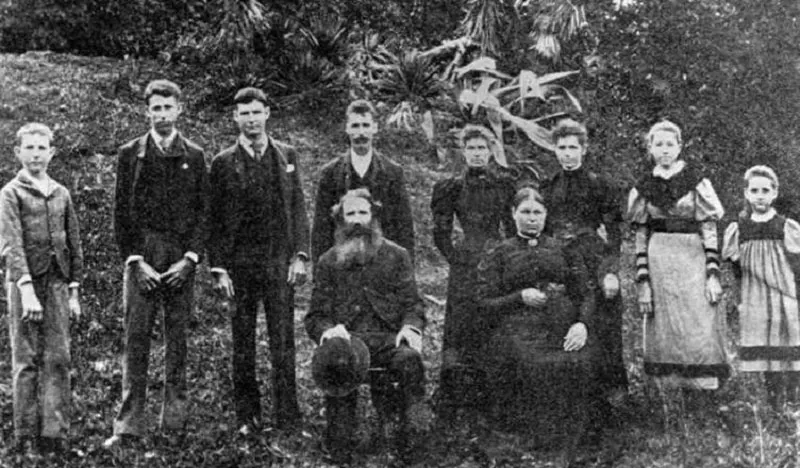
On the night of March 31, 1922, an unimaginable horror descended upon Hinterkaifeck. In a single, savage act of violence, all six inhabitants of the remote Bavarian farmstead were
brutally murdered, extinguishing three generations of the same family and their newly hired
help. The victims, likely bludgeoned to death in the barn or lured there one by one, were:

- Andreas Gruber (63): The stern, sometimes harsh patriarch who ruled the isolated farm. His contentious nature and rumoured conflicts would later fuel speculation about motives for the Hinterkaifeck murders.
- Cäzilia Gruber (72): Andreas’s wife, the family matriarch living out her final years in the seclusion of Hinterkaifeck.
- Viktoria Gabriel (35): The Gruber’s widowed daughter. Her troubled past, including the recent death of her husband and persistent rumours of an incestuous relationship with her own father, Andreas, cast a particularly dark shadow over the family dynamic and became a focal point for investigators.
- Cäzilia Gabriel (7): Viktoria’s young daughter. Her tender age made the brutality of her death especially shocking, highlighting the killer’s utter lack of mercy.
- Josef Gabriel (2): Viktoria’s toddler son, the youngest and most innocent victim. His murder underscored the horrific totality of the crime.
- Maria Baumgartner (44): The family’s newly hired maid. Her presence added a layer of profound tragedy and mystery; she had arrived at Hinterkaifeck only hours before her death, replacing a maid who had fled just days earlier, terrified by unexplained sounds and an overwhelming sense of dread within the farmhouse. Did she unwittingly walk into a death trap already set?

This 1922 farm massacre wasn’t a random attack; it was a calculated, intimate slaughter
targeting every soul residing at Hinterkaifeck. The sheer scale – the murder of six people,
including a toddler and an elderly woman – combined with the ferocity of the attack, sent
shockwaves through Bavaria and cemented the case as one of Germany’s most heinous
unsolved crimes. The killer, or killers, knew the victims and the farm’s layout, likely having
observed them or even hidden on the property before that fatal night. The complete
annihilation of the household remains the chilling core of the Hinterkaifeck mystery.
The Murders: A Night of Horror
The Crime
The horror that unfolded at Hinterkaifeck on the evening of March 31, 1922, was not a
frenzied attack, but a chillingly methodical execution. Using a mattock – a heavy, dual
bladed farming tool resembling a pickaxe, readily available on the isolated property – the
killer turned a common implement of rural life into an instrument of savage death.
The murder weapon itself became a grim signature of the crime, its sheer brutality
suggesting intense rage or cold, detached efficiency.
The killer’s methodical approach is key to the nightmare:

- The Barn Trap: Four victims were systematically lured, one by one, into the dark confines of the farm’s barn – a place of routine work turned charnel house. Andreas Gruber (63) and his wife Cäzilia Gruber (72) were likely the first targets. They were followed by their daughter Viktoria Gabriel (35) and her young daughter, Cäzilia Gabriel (7). Each was brutally slain with the mattock, their bodies left within the barn. The act of luring them suggests the killer was known to the victims, or exploited their trust and routines.

- Invasion of the Home: With the adults and older child eliminated in the barn, the killer then entered the main farmhouse. There, they committed acts of unspeakable cruelty against the most vulnerable:
- Josef Gabriel (2): The toddler was murdered as he slept in his crib, utterly defenseless.
- Maria Baumgartner (44): The new maid, who had arrived only that afternoon, was killed in her bed. Her murder, occurring mere hours after she started her employment, added a layer of profound randomness or perhaps indicated the killer needed to eliminate all potential witnesses.
This systematic slaughter – moving from the barn to the house – reveals a killer who
operated with terrifying confidence and control. The sequence suggests intimate
knowledge of the farm’s layout, the victims’ habits, and the timing needed to carry out
the mass murder without immediate detection. The use of the farm’s own mattock as
the murder weapon points towards premeditation and a deliberate choice, avoiding a
traceable outside weapon. The sheer overkill, particularly against the children and elderly,
cemented the Hinterkaifeck massacre as an act of incomprehensible barbarity. This
calculated, two-stage attack remains a core element fueling the enduring mystery: Who
possessed such cold-blooded resolve, and what motive could justify annihilating an entire
household, down to its sleeping toddler?
The Discovery
For four agonising days after the murders, the bodies at Hinterkaifeck lay undiscovered in
the farm’s suffocating silence. It wasn’t until April 4, 1922 – a Tuesday – that growing
unease among neighbours overcame the farm’s notorious isolation. Alarms had been
quietly mounting: the Gruber family missed Sunday church services, a near-unthinkable
lapse in deeply religious rural Bavaria. Young Cäzilia was absent from school without
explanation. Most tellingly, observant neighbours noted no smoke rising from the
farmstead’s chimneys – a stark sign of abandoned hearths and extinguished life in the
chilly spring air. The farm, usually a hub of activity, had fallen ominously still.
Fueled by mounting dread, a small group of neighbours, led by Lorenz Schlittenbauer (a
local farmer with close ties to the family and rumoured past tensions with Viktoria Gabriel),
decided to investigate. What they stumbled upon would forever scar them and become
etched into criminal lore:
- The Barn: Inside the shadowy barn, they made a gruesome discovery: the bodies of Andreas, Cäzilia (72), Viktoria, and 7-year-old Cäzilia Gabriel were found brutally slain and stacked atop one another, crudely covered with hay like discarded livestock. This methodical concealment hinted at the killer’s cold composure.
- The Farmhouse: The horror deepened within the main house. In her attic bedroom, Maria Baumgartner, the maid hired mere hours before her death, lay murdered in her bed. Upstairs, 2-year-old Josef Gabriel was found dead in his cot, killed as he slept – the ultimate act of merciless brutality.
This frozen tableau of horror, hidden for days just kilometers from a quiet village, transformed Hinterkaifeck from a secluded farm into Germany’s most infamous crime scene. The delay in discovery, caused by the farm’s remoteness and the killer’s grim handiwork, allowed crucial evidence to degrade and the perpetrator ample time to vanish into the surrounding Bavarian woods. Schlittenbauer’s proximity to the victims – and his role in uncovering the scene – would later cast suspicion on him, adding another layer of complexity to this enduring unsolved mystery. The haunting question lingered: Had the killer remained nearby, watching, as the days passed and the bodies lay undiscovered?
Eerie Omens: Strange Occurrences Before the Murders

- Footprints in the Snow: Days before the murders, fresh snowfall revealed mysterious footprints leading from the surrounding forest toward the farmhouse… but none returning. The tracks vanished near the home, implying the trespasser either never left or knew how to conceal their exit. This detail later fueled theories of the killer hiding at Hinterkaifeck before the attack.
- Missing Keys & Objects: Household items – including keys – began vanishing without explanation. The disappearances felt intentional, violating the family’s sense of security and hinting at an intruder’s intimate access to their private spaces.
- Phantom Noises in the Attic: Both the Grubers and their previous maid reported unexplained footsteps, scratching, and whispers emanating from the attic. The sounds grew so persistent that the maid quit just days before the murders, fleeing in terror and later telling neighbors she felt an “evil presence” lurking above her. Her replacement, Maria Baumgartner, would unknowingly walk into this atmosphere of dread on her final day.
- The Unfamiliar Newspaper: Perhaps most chilling was the discovery of a Munich newspaper inside the house – a publication no one subscribed to or purchased. Left conspicuously where the family would find it, the paper acted like a taunting signature, suggesting the intruder not only entered undetected but lingered long enough to leave a deliberate trace.
These events transcended paranoia; they painted a portrait of methodical stalking. The killer likely observed the farm’s routines, tested its vulnerabilities, and may have even lived undetected in the attic or barn – explaining the footsteps and the footprints that led to the house but never away. For the victims, these omens were a death knell they couldn’t escape, trapped by the farm’s crushing isolation. For investigators, they became critical proof of premeditation in the Hinterkaifeck murders, revealing a predator who turned the family’s home into a hunting ground long before March 31st.
How Supernatural Fears Masked a Mortal Threat
- Months before the murders, Hinterkaifeck’s previous maid fled the farmstead in terror, convinced the house was haunted by malevolent spirits. Her resignation wasn’t a whim—it was a desperate escape from the same eerie phenomena that later tormented the Grubers: the phantom footsteps in the attic, the unexplained noises, and the suffocating sense of being watched. At the time, her fears were dismissed as superstition. In hindsight, they were a horrifying preview of the truth: an intruder had already turned Hinterkaifeck into their stalking ground.
- This maid’s experience is critical to understanding the crime’s prelude:
- Her terror confirms the sustained duration of the disturbances—months before the murders—proving the killer’s campaign of intimidation was calculated, not impulsive.
- Her insistence on an “evil presence” (later echoed by the family) suggests the stalker didn’t just visit—they occupied spaces like the attic or barn, explaining footprints that led to the house but never away.
- Her departure created a fatal vacancy. When Maria Baumgartner arrived on March 31st, she unknowingly stepped into a role that had become a death sentence.
- These incidents dismantle any notion of coincidence. The “haunting” was psychological warfare: keys vanished to destabilize; newspapers appeared to assert control; noises in the attic reinforced helplessness. For a killer hiding at Hinterkaifeck, the farm’s isolation wasn’t just an advantage—it was a weapon. The family’s vulnerability grew with every creak above them, every fresh track in the snow. By the time they recognized the threat, it was too late.
- The previous maid’s instinct was tragically correct—but the evil wasn’t supernatural. It was human. Her flight underscores the most chilling theory: the killer didn’t just stalk the family. They lived among them, unseen, turning Hinterkaifeck into a gilded cage with a predator in its walls.
The Investigation

Initial Response
The investigation into Germany’s most infamous unsolved crime began with catastrophic missteps. Inspector Georg Reingruber, dispatched from Munich with a team of detectives, arrived at Hinterkaifeck on April 5, 1922—a full day after neighbors discovered the bodies. What he encountered wasn’t just a crime scene; it was a forensic disaster that would cripple the case for decades. Three fatal flaws defined the initial response:
- Contaminated Crime Scene: A Carnival of Errors
- Before Reingruber’s arrival, the farm had descended into chaos. Neighbors, local police, and morbidly curious onlookers trampled the barn and farmhouse unchecked, obliterating footprints, disturbing bodies, and handling potential evidence. Hay was recklessly cleared from victims, tools were moved, and personal items were touched—all before the scene could be photographed, sketched, or secured. This wholesale contamination destroyed vital clues (like the mysterious footprints leading to the house) and made reconstructing the killer’s actions nearly impossible.
- The Silence of Isolation: Zero Witnesses
- Hinterkaifeck’s crushing remoteness, once a shield for the killer, now became an investigative nightmare. No screams were heard. No strangers were seen approaching the farm. No witnesses could place anyone near the property on the night of March 31st. With the nearest neighbors hundreds of meters away through dense woods, the murders occurred in a void of accountability—leaving Reingruber’s team with no alibis to verify, no suspicious figures to track, and no timeline beyond the victims’ final hours.
- Forensic Stone Age: The Tools of 1922
- Early 20th-century criminal science was woefully unequipped for such brutality. Key limitations included:
- No Blood Analysis: Bloodstain patterns couldn’t be interpreted; blood type matching (a nascent science) wasn’t attempted on the mattock or clothing.
- Fingerprint Fumbles: Dusting for prints was primitive and rarely used in rural Bavaria. Surfaces like the barn door and mattock handle were never properly examined.
- Trace Evidence Blindness: Hair, fibers, or soil on victims went uncollected. The attic (source of pre-murder noises) wasn’t forensically searched.
- Botched Autopsies: Cause of death was crudely noted (“blunt force trauma”), but no detailed wound analysis linked the weapon to specific attackers.
- Reingruber, though experienced, was overwhelmed. Resources were stretched thin, heavy rain later washed away outdoor evidence, and pressure for quick answers led to hasty conclusions. The result? A cold case within weeks—one where the killer’s identity slipped away not through cunning alone, but through investigative neglect. These early failures transformed Hinterkaifeck from a solvable crime into a century-old enigma.
- Early 20th-century criminal science was woefully unequipped for such brutality. Key limitations included:
Autopsy and Evidence:

“The autopsies and crime scene analysis revealed not just violence, but ritualistic savagery that shocked even seasoned investigators. Each discovery painted a darker portrait of the killer’s psyche and their intimate familiarity with Hinterkaifeck:
- Unspeakable Brutality: Beyond Murder
- Every victim suffered multiple crushing blows to the head from the mattock, confirming the killer’s relentless overkill. Most haunting was the fate of 7-year-old Cäzilia Gabriel: forensic evidence showed she survived for hours after the assault, lying paralyzed but conscious beneath the bodies of her family in the hay-strewn barn. In her final moments of unimaginable agony, she tore clumps of her own hair out—a detail that exposed the killer’s cruelty in leaving a child to die slowly. This wasn’t just homicide; it was erasure of an entire bloodline.

- The Murder Weapon: A Tool of Terror
- The mattock, a dual-bladed implement used daily on the farm, was recovered hidden inside the barn itself—likely concealed in the same space where four lives were extinguished. Its discovery confirmed the killer used what was readily available, avoiding traceable outside weapons. Forensic analysis (rudimentary by modern standards) found hair and tissue embedded in its blade, but no usable fingerprints due to the weapon’s rough wooden handle and contamination by investigators.
- The Killer’s Chilling Aftermath: Lingering in the Shadows
- Most unnerving were signs the murderer stayed at Hinterkaifeck for days after the slaughter:
- Animals Fed: Cows were tended, proving the killer knew farm routines.
- Meals Consumed: Food was eaten from the pantry, with dishes left in the sink—a macabre act of domestication.
- Fires Lit: Embers in the hearth confirmed someone warmed themselves in the victims’ home, surrounded by corpses.
- This behavior revealed a killer of psychopathic calm—someone who felt no urgency to flee, who treated the farm as their birthright. The mattock’s concealment on-site and the care taken to sustain the property suggested a deeply personal connection to Hinterkaifeck. Were they ensuring the crime remained hidden? Savoring their victory? Or simply waiting for the next victim to arrive?
- Together, these clues—Cäzilia’s prolonged suffering, the hidden mattock, and the killer’s multi-day occupation—created a profile of a perpetrator both merciless and methodical. Yet without modern forensics, this evidence became a dead end. The killer had walked through the crime scene not as a ghost, but as a flesh-and-blood shadow who knew Hinterkaifeck’s secrets intimately.
Theories and Suspects
Despite extensive investigation, no one was ever charged. Over the years, several suspects and theories have emerged.

- Lorenz Schlittenbauer
- A neighbor and member of the search party, Schlittenbauer had a complicated relationship with the Gruber family. He was rumored to be the father of Josef, Viktoria’s young son, and was involved in disputes over paternity and inheritance. Some found his behavior at the crime scene suspicious—he was the first to enter the house and seemed oddly familiar with the property. However, there was no concrete evidence linking him to the murders.
- The Bichler Brothers and Georg Siegl
- Anton and Karl Bichler, former farmhands, and Georg Siegl, who had worked at Hinterkaifeck, were suspected due to their knowledge of the farm and previous criminal behavior. Anton had reportedly expressed animosity toward the family, and the farm dog did not bark at him, suggesting familiarity. Still, no charges were ever filed.
- Peter Weber
- A laborer who had once discussed robbing the Grubers with a coworker. He knew about the family’s wealth and the rumors of incest between Andreas and Viktoria. Again, no evidence was found to implicate him.
- Unknown Intruder
- Some theorize that a vagrant or itinerant worker committed the murders, possibly motivated by robbery. However, money and valuables were left untouched, making this theory less likely.

- Family Secrets and Incest
- Rumors of incest between Andreas and Viktoria, and disputes over Josef’s paternity, have fueled speculation that the motive was personal—perhaps revenge or jealousy. These theories, however, remain unproven.
Challenges of the Case
Forensic Limitations
The Hinterkaifeck murders were crippled by 1920s forensic limitations. When victims’ skulls went to Munich for analysis, results proved inconclusive – era techniques couldn’t extract meaningful clues from wounds or match the mattock weapon. Decades later, 1990s DNA analysis on degraded evidence failed due to irreversible evidence degradation. Biological samples stored improperly for 70+ years yielded no profiles despite advanced mitochondrial testing. These forensic failures – primitive science followed by time’s erosion – ensured Germany’s most haunting cold case remains unsolved, with critical evidence lost to history.
Rural Isolation
Hinterkaifeck’s extreme remoteness – 70km from Munich in snowbound Bavarian woods – created critical investigation roadblocks. Police struggled to secure the scene quickly or track suspects across isolated terrain. Worse, the tight-knit rural community’s reluctance to speak fostered an omertà-like silence. Neighbors feared accusing locals or attracting scandal, withholding potential alibis, grudges, and rumors about the Gruber family disputes. This deadly combination of geographic isolation and communal secrecy starved investigators of leads, turning Hinterkaifeck into Germany’s most infamous unsolved Bavarian crime.
Contaminated Evidence
The 4-day delay in discovering bodies gave the Hinterkaifeck killer crucial time to tamper with evidence – potentially staging the scene or removing traces. Worse, when neighbors and local police arrived before Munich investigators on April 4-5, 1922, they contaminated the crime scene irreparably: moving bodies, disturbing the mattock, and trampling potential footprints in the barn and farmhouse. This chaotic pre-inspection destroyed blood patterns, obscured intruder traces, and compromised Germany’s most infamous unsolved Bavarian crime before Georg Reingruber’s team even secured the area.
Theories That Endure
A century later, Germany’s most infamous unsolved Bavarian crime still torments investigators and true crime audiences. Key mysteries feed its haunting legacy: Was the killer a local driven by family revenge (like suspect Lorenz Schlittenbauer)? Did they truly stalk the farm for days, hidden in the attic as pre-murder noises suggested? Or was it a transient killer versus an insider exploiting intimate knowledge of the isolated homestead? The absence of motive, calculated brutality, and the killer’s eerie post-crime occupation of Hinterkaifeck cement its status as an eternal cold case—where truth remains buried deeper than the victims themselves.
Cultural Impact and Legacy
Influence on Crime Investigation
The Hinterkaifeck murders remain a pivotal case in forensic science history, exposing critical flaws in 1920s rural policing. Its investigative failures – contaminated scenes, primitive forensics, and community distrust – became a textbook example of how not to handle crime scenes. This unsolved Bavarian tragedy directly influenced modern cold case protocols, driving innovations in evidence preservation, witness isolation, and rapid response teams. Today, criminologists still study Hinterkaifeck as the definitive pre-modern cold case, proving how historical failures can forge stronger justice systems while the farm’s shadows linger in Germany’s collective memory.
In Popular Culture
The Hinterkaifeck murders have become a true crime phenomenon, inspiring countless documentaries (like “The Hinterkaifeck Murders” by ZDF), bestselling books (Annette Görtz’s Hinterkaifeck), and chilling film adaptations (Tannöd). Its status as Germany’s most haunting unsolved crime fuels endless podcast deep dives (Casefile, RedHanded) and viral online discussions across Reddit forums and true crime communities. The case’s potent mix of rural isolation, pre-crime stalking, and forensic failures sustains its grip on the public imagination – cementing Hinterkaifeck as a global icon of unresolved mystery that continues to terrify and fascinate new generations.
Societal Reflections
Vulnerability of Isolation: Spotlighting how remote rural communities face heightened risks due to limited policing, delayed emergency response, and geographic barriers – turning farms like Hinterkaifeck into hunting grounds for predators.
Familial Secrets & Violence: Exposing the dark undercurrents within households, where hidden abuse, paternity disputes, inheritance conflicts, and intergenerational trauma can erupt into lethal violence. Century-Long Quest for Justice: Reflecting humanity’s inescapable need for closure, as seen in global true crime fascination, crowdsourced investigations, and renewed forensic efforts to solve historic atrocities.
Why the Case Remains Unsolved

The Hinterkaifeck murders persist as Germany’s top cold case due to a perfect storm of investigative failures: Absolute lack of witnesses in the isolated Bavarian woods meant no sightings or alibis. Critical evidence contamination occurred when neighbors trampled the scene before Munich police secured it. 1920s forensic limitations left blood, trace evidence, and the murder weapon useless for modern analysis. Rural community silence, driven by distrust and fear of accusing neighbors, buried vital local knowledge. Most hauntingly, the absence of clear motive transformed this family annihilation into an enduring riddle—where revenge, greed, and madness theories linger but vanish like the killer into history’s shadows.
Conclusion
The Hinterkaifeck murders endure as Germany’s most haunting unsolved crime, a century-old enigma where brutal family annihilation, eerie premonitions, and catastrophic investigative failures collided. Its legacy transcends history – embodying the limits of 1920s forensics, the vulnerability of rural isolation, and humanity’s obsession with unresolved darkness. For true crime audiences and experts alike, Hinterkaifeck remains the definitive pre-modern cold case: a wound that refuses to heal. Yet as podcasts dissect its clues and forensic advances reignite hope, the question still chills: Will new DNA tech or a deathbed confession finally expose the killer hiding in history’s shadows? Until then, the farm’s silence screams louder than any solution.
Discover more from TrueVerses
Subscribe to get the latest posts sent to your email.