
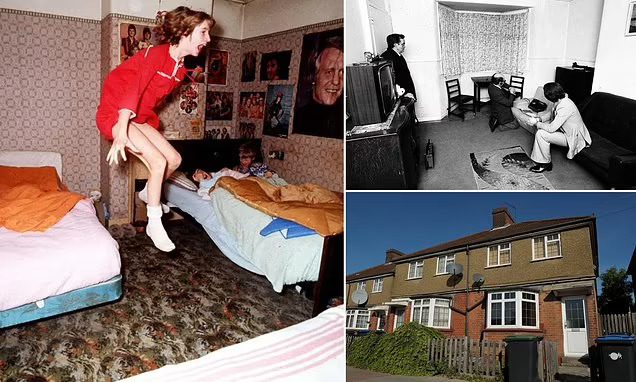
Step inside 284 Green Street, Enfield, North London, and you enter the epicenter of one of the most famous, intensely debated, and genuinely chilling paranormal investigations of the modern era. The Enfield Poltergeist case, unfolding relentlessly between 1977 and 1979, remains a cornerstone of poltergeist phenomena and a defining moment in 20th-century paranormal history. For over eighteen months, this seemingly ordinary council house became a crucible of inexplicable terror. Furniture levitated, objects flew with violent force, disembodied voices rasped from the walls, and disturbing physical manifestations targeted the Hodgson family – primarily two young sisters. These events didn’t just disturb a North London neighbourhood; they captivated a global public, perplexed seasoned investigators from the prestigious Society for Psychical Research (SPR), and ignited fierce controversies that rage on decades later. The Enfield Poltergeist transcends a mere ghost story; its complex legacy, cemented by countless books, documentaries, films, and dramatizations (including major productions like The Conjuring 2), continues to fascinate believers, challenge skeptics, and fuel endless discussions about the boundaries of our reality. Was it genuine supernatural terror, elaborate hoax, or a complex psychological phenomenon? The debate is the enduring power of the Enfield case.
The Setting: 284 Green Street, Enfield
The Hodgson Family: An Ordinary Home, An Extraordinary Nightmare

At the heart of this chilling saga lies the Hodgson family, whose lives were irrevocably altered within the walls of their unassuming home. Peggy Hodgson, a resilient single mother, faced the everyday challenges of raising her four children in their modest council house at 284 Green Street, Brimsdown, Enfield. Her children were Margaret (13), Janet (11), and her two younger sons, Johnny and Billy. Like countless families across North London in the late 1970s, their life was defined by routine and the quiet resilience of working-class Britain. Peggy Hodgson managed the household, while her children navigated school, friendships, and the ordinary dramas of childhood. There was nothing to suggest that 284 Green Street was anything other than a typical family home.
That all changed irrevocably in August 1977
Without warning, the Hodgson’s predictable world was shattered by a relentless onslaught of bizarre and terrifying events. What began as unsettling, unexplained noises – knocks in the walls, shuffling sounds with no visible source – rapidly escalated into phenomena that defied rational explanation. The epicenter of this disturbance seemed to coalesce around the children, particularly the two sisters, Margaret and Janet Hodgson. Their council house in Brimsdown, Enfield, transformed almost overnight from a place of safety into a crucible of fear, marking the terrifying beginning of what would become known worldwide as The Enfield Poltergeist case. The quiet street in North London was about to become infamous.
The Haunting Begins
It all started when Peggy Hodgson reported to the police that heavy furniture was moving on its own, and her daughters, Janet and Margaret, were hearing persistent knocking sounds emanating from the walls. The disturbances escalated rapidly: toys were thrown across rooms, chairs overturned, and the children claimed to be physically attacked by unseen forces. One police officer who responded to the call reported witnessing a chair “wobble and slide” across the floor, though the cause could not be determined.
Media Frenzy and Eyewitness Accounts
The Hodgson family’s terrifying ordeal quickly attracted intense media attention. The Daily Mirror sent reporters and photographers to 284 Green Street, capturing images of the chaos and publishing sensational front-page stories. This thrust the family – especially sisters Janet and Margaret Hodgson – into the national headlines.Adding significant weight, BBC Radio 4 produced a chilling documentary featuring firsthand accounts recorded inside the house. Listeners heard unsettling phenomena, including the infamous deep “growling voice” claiming to be Bill Wilkins, a deceased former resident.This media frenzy transformed the Enfield Poltergeist case from a local haunting into a global phenomenon, fueling public fascination and debate that continues decades later.
Among them was Daily Mirror journalist Graham Morris, who claimed direct experience of the phenomena. Morris reported being struck by a flying Lego brick during his time in the house. Crucially, he captured iconic photographs and audio recordings purportedly documenting the inexplicable events, becoming a firsthand witness whose evidence remains central to the Enfield Poltergeist case.
Among them was Daily Mirror journalist Graham Morris, who claimed direct experience of the phenomena. Morris reported being struck by a flying Lego brick during his time in the house. Crucially, he captured iconic photographs and audio recordings purportedly documenting the inexplicable events, becoming a firsthand witness whose evidence remains central to the Enfield Poltergeist case.
Beyond physical disturbances, many witnesses heard and documented persistent knocking sounds and peculiar disembodied voices. Most chillingly, 11-year-old Janet Hodgson was frequently heard speaking in an unnervingly deep, gruff voice – a stark, disturbing contrast to her natural high-pitched child’s tone. This guttural voice identified itself as “Bill Wilkins,” a man claiming to have died in the house, becoming one of the most iconic elements of the Enfield Poltergeist evidence.
The Investigators: Maurice Grosse and Guy Lyon Playfair

The escalating phenomena prompted the prestigious Society for Psychical Research (SPR) to intervene. They dispatched investigator Maurice Grosse, a recent SPR member and professional inventor, to lead the inquiry. Grosse, driven by a personal quest for understanding after his daughter’s tragic death, became deeply invested in the Enfield case. He established a near-daily presence at 284 Green Street, meticulously documenting events alongside fellow researcher Guy Lyon Playfair. Grosse’s unique background and intense commitment made him a central figure in the Enfield Poltergeist investigation, spearheading the effort to apply scientific scrutiny to the relentless phenomena.
The escalating phenomena prompted the prestigious Society for Psychical Research (SPR) to intervene. They dispatched investigator Maurice Grosse, a recent SPR member and professional inventor, to lead the inquiry. Grosse, driven by a personal quest after his daughter’s tragic death, became deeply invested in the Enfield case. He was soon joined by seasoned SPR investigator and author Guy Lyon Playfair. Together, Grosse and Playfair immersed themselves at 284 Green Street, becoming the core investigators who meticulously logged phenomena over hundreds of hours. Their rigorous on-site documentation formed the foundation of Playfair’s influential book, This House is Haunted, cementing their roles as central figures in the Enfield Poltergeist investigation
Grosse and Playfair became firsthand witnesses to astonishing phenomena at 284 Green Street, meticulously documenting:
- Unexplained Sounds: Curious whistling and barking noises seemingly emanating from Janet Hodgson.
- Projectile Objects: Furniture and household items hurled across rooms with violent force, shattering ornaments and light fittings.
- Kinetic Utensils: Teaspoons inexplicably sliding across kitchen worktops.
- Furniture Levitation: A heavy living room sofa reportedly levitating before crashing down upside down.
- Physical Assaults: Janet Hodgson violently thrown from her bed – an event captured on camera.
Based on their intensive investigation, Guy Lyon Playfair authored the influential book This House is Haunted: The True Story of a Poltergeist (1980). As the lead SPR investigator on the case, Playfair presented a detailed analysis, arguing that while some incidents suggested possible trickery, the sheer volume, nature, and witnessed evidence of the phenomena led him to conclude that much of the Enfield Poltergeist activity was genuinely inexplicable. His book remains a cornerstone text and essential reading on the case.
The Warrens Arrive

The Enfield Poltergeist’s notoriety reached across the Atlantic, attracting Ed and Lorraine Warren – the renowned American paranormal investigators famed for their work on the Amityville Horror. In 1978, the Warrens visited 284 Green Street. Lorraine Warren, a clairvoyant, claimed to sense the presence of “Bill Wilkins,” the troubled spirit who reportedly died there. Ed Warren, a demonologist, offered a darker interpretation, suspecting demonic involvement and warning the poltergeist activity could escalate into far more dangerous phenomena. Their high-profile visit added another layer of complexity and controversy to the case.
The Enfield Poltergeist’s notoriety reached across the Atlantic, attracting Ed and Lorraine Warren – the renowned American paranormal investigators famed for their work on the Amityville Horror. In 1978, the Warrens visited 284 Green Street. Lorraine Warren, a clairvoyant, claimed to sense “Bill Wilkins,” the troubled spirit who reportedly died there. Ed Warren, a demonologist, suspected demonic involvement, warning the activity could escalate.During their investigation, the Warrens conducted interviews, reviewed evidence, and performed religious rituals attempting to communicate with and pacify the entity. While their high-profile involvement amplified global attention, it also fueled increased skepticism. Critics argued their theatrical methods sensationalized the events, further polarizing opinions on the case’s authenticity.
The Evidence: Recordings, Photographs, and Eyewitness Testimony

The Enfield Poltergeist case stands out for its sheer volume of firsthand documentation. Lead investigators Maurice Grosse and Guy Lyon Playfair amassed hundreds of hours of audio recordings, still photographs, and meticulous written logs during their 18-month vigil. Crucially, journalists (like the Daily Mirror’s Graham Morris) and BBC documentary crews simultaneously captured images and audio inside 284 Green Street. This rare convergence of professional paranormal investigation and media documentation created an unparalleled archive of poltergeist phenomena – from disembodied voices to flying objects and physical traces – making it one of the most heavily scrutinized paranormal cases in history.
The Enfield Poltergeist generated uniquely tangible proof, with three forms of evidence dominating analysis:
“Bill Wilkins” Voice Recordings: Audio tapes captured 11-year-old Janet Hodgson producing a guttural, male voice – often identifying as “Bill Wilkins” (a former resident) – starkly contrasting her natural voice. These recordings remain core audio evidence of paranormal claims.Levitation Photographs: Controversial still images, including those taken by Daily Mirror photographer Graham Morris, allegedly show Janet levitating mid-air or violently thrown from her bed – some of the most visually debated poltergeist evidence in history.Independent Eyewitness Testimony: Signed statements from police officers, neighbors, SPR investigators, and journalists consistently described witnessing objects moving, furniture shifting, and unexplained noises with no discernible cause, providing crucial third-party corroboration.
As BBC broadcaster and “Uncanny” host Danny Robins observes, the Enfield Poltergeist stands as “the most photographed haunting in UK history” – even if not universally deemed the most credible. This prolific visual record, from levitation claims to flying objects captured by journalists and investigators, transformed the case into iconic imagery. These photographs and recordings fueled the story’s enduring fascination, inspiring major dramatizations like The Conjuring 2 and cementing Enfield’s place in paranormal pop culture, regardless of ongoing debates about authenticity.
Skepticism and Controversy
Despite its unprecedented documentation, the Enfield Poltergeist case remains fiercely debated. Organized skepticism emerged prominently from the Committee for the Scientific Investigation of Claims of the Paranormal (CSICOP). Expert investigators like stage magicians Milbourne Christopher and Joe Nickell argued that Grosse and Playfair displayed excessive credulity. They contended that much of the phenomena – including object movement and Janet’s “Bill Wilkins” voice – could be explained by deliberate trickery or psychological suggestion (like mass hysteria), challenging the case’s paranormal claims.
The Enfield Poltergeist’s credibility faced its most significant test when evidence of trickery emerged. Critically, Janet Hodgson was filmed bending spoons and attempting to bend an iron bar. Investigator Maurice Grosse also observed her banging a broom handle on the ceiling (simulating unexplained knocks) and hiding his tape recorder to obstruct documentation. Most damagingly, both Janet and Margaret Hodgson admitted to journalists that they had faked some incidents.Though the sisters later retracted these confessions – reportedly under pressure from Grosse and Playfair – skeptics seized upon these events. Critics argued these documented hoaxes, combined with the investigators’ apparent desire to believe, fundamentally undermined the case’s paranormal claims, suggesting wishful thinking amplified childish pranks into a legendary haunting.
Theories and Explanations
The Enfield case has inspired a range of theories:
- Overwhelming Witness Consensus: Police officers, journalists, neighbors, and SPR investigators independently reported identical bizarre phenomena – validating core events.
- Physical Traces & Audio Evidence: Unexplained scratches, levitation photos, and the “Bill Wilkins” voice recordings resisted debunking despite scrutiny.
- Investigator Conviction: Grosse and Playfair – present for 18 months – maintained much activity defied natural explanation, even acknowledging some hoaxes didn’t negate the whole case.
- Recurrent Spirit Identity: Consistent claims of “Bill Wilkins” (verified as a former resident) across sessions adds narrative coherence skeptics struggle to dismiss as pure fabrication.
The Aftermath and Legacy
By 1979, the intense paranormal disturbances at 284 Green Street, famously known as the Enfield Poltergeist case, had mostly subsided. However, the Hodgson family, particularly Janet, continued to experience and report unexplained activity for years. In later interviews, Janet described the haunting as deeply traumatic, strongly maintaining that not everything was fabricated or faked.
The Enfield Poltergeist has become a cultural phenomenon, inspiring countless books, documentaries, and dramatizations over the years. Notably, it was the basis for the 2016 film The Conjuring 2 and the Sky Living miniseries The Enfield Haunting. What keeps the Enfield Poltergeist case alive in public fascination is the enduring mystery surrounding it—a haunting filled with eyewitness accounts, recordings, and photographs, yet still lacking a clear, definitive explanation.
Conclusion
The Enfield Poltergeist case remains one of the most well-documented and debated hauntings in modern paranormal history. Whether seen as a true encounter with the supernatural, a psychological phenomenon, or an elaborate hoax, it continues to fascinate researchers, skeptics, and believers alike. The mystery of what truly happened at 284 Green Street may never be fully solved, but the case endures as a powerful reflection of human belief, the complexities of the mind, and our timeless intrigue with the unexplained.
Discover more from TrueVerses
Subscribe to get the latest posts sent to your email.

